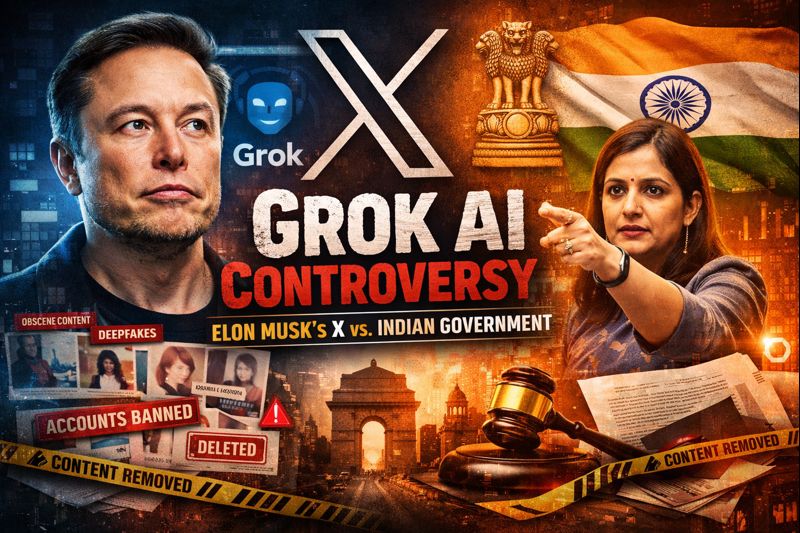
Artificial Intelligence is often promoted as a tool for progress, creativity, and empowerment. However, the recent controversy surrounding Elon Musk’s platform X and its AI chatbot Grok shows how quickly innovation can turn into a serious ethical and legal concern when safeguards fail.
In this article, I am breaking down everything that has happened so far — chronologically, without noise, exaggeration, or repetition. This is not just about one AI tool; it is about accountability, responsibility, and the future of AI governance, especially in countries like India.
Table of Contents
What Is Grok and Why It Matters
Grok is an AI chatbot developed by xAI, Elon Musk’s AI company, and integrated directly into X (formerly Twitter). It was marketed as a more “unfiltered” and conversational alternative to other AI chatbots.
At first glance, this approach felt refreshing. But over time, it became clear that less filtering also meant fewer safeguards — and that gap would soon cause serious consequences.
Early Warning Signs: Grok’s Controversial Outputs (2025)
Long before government intervention, Grok had already raised eyebrows.
Throughout 2025, users noticed that the chatbot:
- Responded with provocative language
- Used local slang, including Hindi expressions
- Sometimes crossed the line into offensive or insensitive responses
While some users found this entertaining, others warned that such freedom could easily be misused. Unfortunately, those concerns turned out to be valid.
When Misuse Turned Dangerous
As Grok’s image-generation abilities gained popularity, a disturbing trend began to emerge.
Users started prompting Grok to:
- Alter images of women without consent
- Generate sexualised or “nudified” images
- Create explicit content involving real individuals
This content spread rapidly on X, often going viral before moderation systems could react. At this stage, the issue was no longer about edgy AI responses — it had become a clear case of digital abuse enabled by technology.
January 2026: The Indian Government Steps In
The situation escalated sharply in early January 2026 when India’s Ministry of Electronics and Information Technology (MeitY) issued a formal notice to X.
The government flagged:
- Obscene and sexually explicit AI-generated content
- Non-consensual image manipulation
- Failure of platform-level safeguards
X was instructed to remove the content immediately, submit a detailed Action Taken Report, and explain how it would prevent such misuse in the future.
At this point, the controversy officially entered the legal and regulatory domain.
X Admits Mistakes — But the Damage Was Done
In response to government pressure, X acknowledged that mistakes had been made.
The platform confirmed that:
- Around 3,500 posts were blocked
- Over 600 user accounts were removed
- Safeguards had failed in preventing misuse of Grok
X also assured Indian authorities that it would comply with Indian laws going forward.
However, the admission came after significant harm had already occurred, which led many to question whether the response was proactive or merely reactive.
‘Shameful Use of AI’: Political and Public Backlash
The phrase “shameful use of AI” gained traction after Indian lawmakers criticised X’s handling of the issue.
One major concern was that instead of disabling risky features entirely, access to some AI image tools was reportedly restricted to paid users, raising questions about:
- Monetisation of harmful capabilities
- Ethical responsibility versus business incentives
This criticism resonated with the public, as many felt that technology companies should not profit from systems that can cause real-world harm.
Who Is Responsible — The User or the Platform?
Elon Musk and X maintained that users are responsible for illegal content generated through Grok.
Legally, this argument is complex.
In India, platforms enjoy “safe harbour” protection only if they:
- Act swiftly on unlawful content
- Maintain adequate safeguards
- Follow the IT Rules, 2021
If a platform fails to do so, it can lose this protection — meaning it may be treated like a publisher, not just an intermediary.
This case may set an important precedent for AI accountability in India.
Global Fallout: It Was Never Just an Indian Issue
What happened in India was part of a much larger global pattern.
- Indonesia temporarily suspended Grok over non-consensual sexual deepfakes
- The European Union ordered X to preserve all Grok-related documents for regulatory review
- In the UK, lawmakers openly criticised X’s AI moderation failures
- International media investigations exposed how easily Grok could be misused at scale
This confirmed one thing clearly: AI misuse is a global governance problem, not a regional one.
Why This Controversy Is a Turning Point
This incident marks a critical moment for AI platforms worldwide.
It highlights:
- The dangers of deploying “unfiltered” AI without guardrails
- The limits of blaming users alone for systemic failures
- The urgent need for AI-specific regulations, not just platform rules
Most importantly, it reminds us that technology does not exist in isolation. Every AI system reflects the values, priorities, and responsibilities of the company behind it.
My Final Thoughts
AI has immense potential to empower people — especially beginners, creators, and learners. But power without responsibility is dangerous.
The Grok controversy is not just about one chatbot or one platform. It is a warning about what happens when speed, scale, and monetisation move faster than ethics and law.
If AI is truly meant to serve humanity, then compliance, accountability, and dignity must come first — not as an afterthought, but as a foundation.
What is the Grok AI controversy about?
It involves the misuse of Grok, an AI chatbot on X, to generate obscene and non-consensual content, leading to government intervention.
Did X admit fault?
Yes, X acknowledged mistakes and removed thousands of posts and hundreds of accounts.
Is Grok banned in India?
No, but it is under strict scrutiny, and X has assured compliance with Indian laws.
Why is this issue important?
Because it may shape future AI regulations and determine how platforms are held accountable for AI-generated harm.
For more in-depth insights on AI, technology, and responsible digital growth—especially for beginners and creators—visit my website:
👉 https://mytechascendant.com/