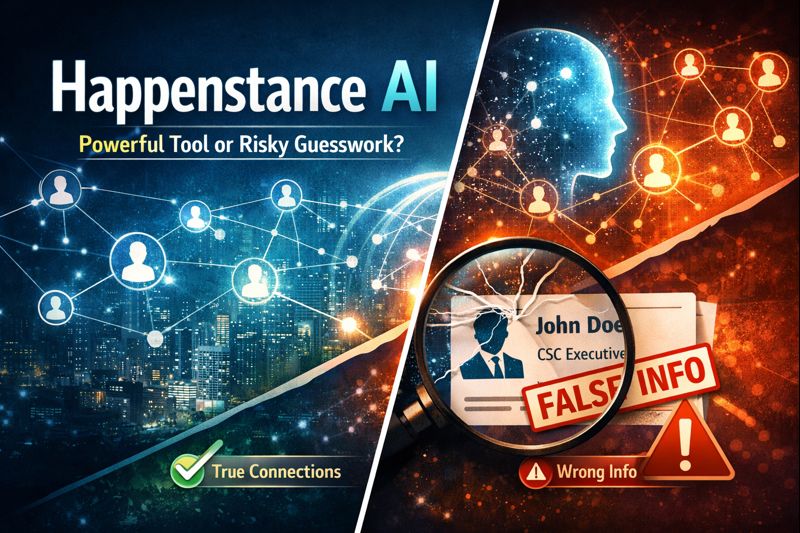
AI tools are steadily reshaping how people search, connect, and make professional decisions. From content creation to automation, from hiring to networking, algorithms now sit quietly between humans and opportunities. Happenstance AI enters this space with an ambitious promise: it claims to help people discover meaningful connections hidden inside their existing networks. The idea is seductive. Instead of endlessly scrolling LinkedIn, instead of relying on memory or luck, an AI assistant claims it can surface the right people instantly.
That promise alone explains why Happenstance AI has attracted attention among founders, recruiters, creators, and network-driven professionals. Yet real-world usage reveals a more complex story. Powerful capability exists alongside real limitations. In some cases, those limitations are not minor inconveniences but structural weaknesses that users need to understand clearly.
This review looks at Happenstance AI as it actually behaves, not as it is marketed. It examines both advantages and disadvantages, including the issue of incorrect or misleading information surfaced by the system.
Table of Contents
What Happenstance AI Is Trying to Do
Happenstance AI positions itself as a people discovery engine rather than a traditional social network. It does not attempt to replace LinkedIn or email. Instead, it layers intelligence on top of existing connections. Users connect accounts like Gmail, LinkedIn, Twitter/X, or other platforms. The system then scans those connections and allows searches written in natural language.
A user might type a name, a role, an industry, or even a vague description of someone they hope exists within their network. The AI attempts to map digital traces and return relevant people.
This approach reflects a broader shift in AI design. Instead of building new platforms from scratch, many tools now try to extract value from what users already have. Contact lists, inboxes, social graphs, and interaction histories become raw material for inference.
In theory, this is efficient. In practice, it introduces ambiguity.
The Strength of Intent-Based Networking
One area where Happenstance AI genuinely excels is intent-based search. Traditional networking often relies on memory or manual filtering. A person tries to recall who works where, who might know whom, who once mentioned a relevant topic. That mental process breaks down as networks grow larger.
Happenstance replaces memory with search. The ability to type a sentence instead of applying rigid filters changes the experience. It feels closer to thinking than to form-filling. This matters especially for non-technical users and beginners.
For someone with a large inbox, a long professional history, or scattered social connections, this can unlock dormant relationships. Old contacts resurface. Forgotten introductions appear. Weak ties gain visibility.
Used in this way, the tool feels less like surveillance and more like augmentation.
Discovery Versus Accuracy
The core value of Happenstance lies in discovery. The problem arises when discovery is confused with verification.
The system does not pull from authoritative employment databases. It does not confirm job titles with companies. It does not check whether a role is current, historical, or even real. It infers.
Inference is not knowledge. Inference is pattern matching based on incomplete data.
When a person’s digital footprint is rich, clear, and consistent, inference may appear accurate. When a person’s footprint is fragmented, outdated, or minimal, inference turns speculative. The AI still produces output. Silence is rarely an option for generative systems. Something is shown even when confidence should be low.
This creates a dangerous illusion of certainty.
The Issue of False or Incorrect Information
One of the most important limitations of Happenstance AI is the appearance of incorrect professional details. A user may search a real individual by name and see a company affiliation or job role that the person never had. This is not an edge case. It is a predictable outcome of how the system works.
The AI attempts to assemble a profile from fragments. Mentions in emails, shared contacts, overlapping networks, indirect references, or similar names can all influence the output. If the system encounters signals associated with a company like CSC, it may attribute that company to the wrong individual.
The result looks polished. The confidence feels convincing. The information may be false.
This behavior resembles what is commonly called hallucination in AI systems. The model fills gaps with statistically plausible answers rather than verified facts. The user sees a clean result without seeing the uncertainty behind it.
Common Names and Identity Collisions
The problem becomes more severe with common names. In regions like India, names often follow similar structures. First name, middle name, surname combinations repeat across thousands of individuals. AI systems struggle with identity separation unless strong unique identifiers exist.
Happenstance AI does not always distinguish between multiple people sharing the same name. Signals from different individuals can merge into a single inferred profile. Employment history from one person may appear attached to another. Network proximity may override reality.
This leads to misattribution. A person may be shown working at an organization they never joined. Another may inherit roles they never performed.
For users unaware of this limitation, the output feels authoritative. For those who know the person personally, the error becomes obvious.
Lack of User Correction Mechanisms
Once incorrect information appears, users have limited ability to fix it. There is no robust system for disputing inferred roles. There is no simple way to mark a result as wrong and see it corrected in future searches. Errors can persist.
This creates a feedback imbalance. The AI learns from data but not always from correction. Mistakes become sticky.
In professional contexts, this matters. Recruiters, founders, or collaborators may act on inaccurate assumptions. Warm introductions may be framed around wrong roles. Trust can erode quietly.
Dependence on Network Quality
Happenstance AI is only as strong as the data feeding it. A user with a large, active, professionally dense network may see impressive results. A user with a smaller or fragmented network may see thin or misleading output.
The tool does not compensate for missing data. It extrapolates. Extrapolation without grounding produces noise.
This uneven experience explains why reviews of Happenstance vary widely. Some users describe it as transformative. Others find it unreliable. Both experiences can be true simultaneously.
Privacy and Data Sensitivity
To function, Happenstance requires access to personal networks. Emails, contacts, social graphs all become inputs. This access enables its core value. It also raises legitimate concerns.
Users must trust that their data is handled responsibly, stored securely, and not misused. Even when policies are stated clearly, the mere act of granting access introduces risk. For privacy-conscious users, this alone may be a deal-breaker.
The tradeoff becomes clear. More access enables better inference. Better inference still does not guarantee truth.
Where Happenstance AI Truly Fits
Despite its flaws, Happenstance AI is not useless. It simply needs to be framed correctly.
It works best as an exploratory layer. It surfaces possibilities rather than facts. It helps users ask better questions rather than providing final answers. It assists memory rather than replacing verification.
When used this way, the tool can feel empowering. When used as a source of truth, it becomes misleading.
A Broader AI Pattern
The issues seen in Happenstance AI reflect a broader reality across AI tools. Many systems optimize for usefulness and speed rather than accuracy and humility. The interface presents outputs cleanly while hiding uncertainty.
This creates a mismatch between how humans interpret information and how machines generate it. Humans assume intention and knowledge. Machines operate on probability.
Until AI systems expose uncertainty more clearly, users must supply skepticism manually.
Final Perspective
Happenstance AI represents both the promise and the risk of modern AI. It shows how powerful network intelligence can be when paired with natural language interfaces. It also demonstrates how easily AI can mislead when inference is mistaken for fact.
The tool is not broken. It is unfinished in a deeper sense. It reflects the current stage of AI development, impressive yet unreliable, confident yet unsure.
Used thoughtfully, it can unlock value. Used blindly, it can distort reality.
The responsibility ultimately sits with the user. AI can assist. It cannot verify. It can suggest. It cannot confirm.
Understanding that distinction is no longer optional. It is essential.
Q1: What is Happenstance AI?
An AI-powered networking tool to find people in your connected networks using natural-language queries.
Q2: Is it accurate?
Partially. It can show false job titles or companies because it infers from incomplete data.
Q3: Is it free?
Yes, with a limited free tier. Paid plans unlock more searches and features.
Q4: Who should use it?
Professionals, recruiters, salespeople, or anyone wanting to discover connections in their network.
Q5: How to verify results?
Cross-check with LinkedIn, official directories, or ask the person directly.
For a deeper dive into using Happenstance AI to discover people, make connections, and navigate its advantages and limitations, check out my detailed guide: Happenstance AI Networking and People Discovery.