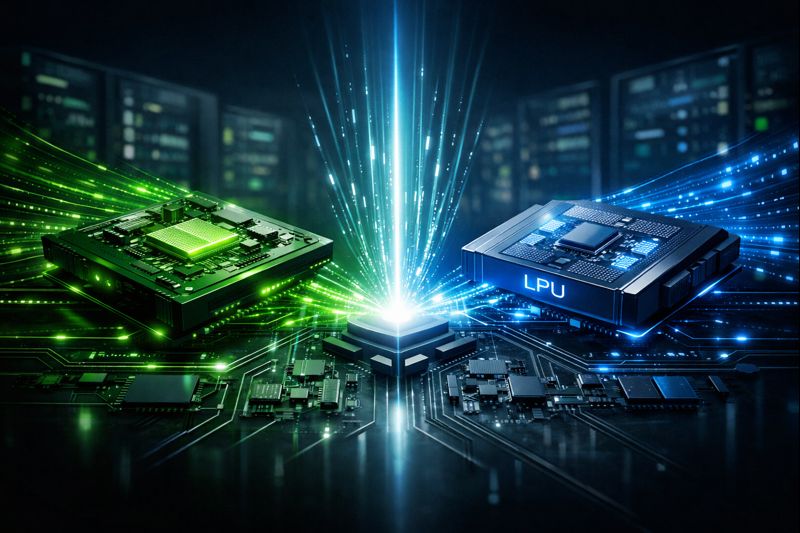
The deal between Nvidia and Groq was announced a few days ago – in which Nvidia has licensed some of Groq’s technology and hired some of its top team, including Groq founder Jonathan Ross. Most people saw this as another normal step in the fast-moving AI chip race.
But in my opinion, it’s not just about speed, benchmark numbers or the company’s valuation. This is actually an attempt by Nvidia – to control where AI computing will go, so that it does not get out of their hands and divide uncontrollably.
For some time now, Nvidia’s GPUs have been the cornerstone of AI training – especially in large language models and data center-based tasks. They have almost become a default standard.
But when AI goes out of training and is used in the real world, “inference” becomes the main problem. Inference means low latency, predictable results, and low power consumption. Here the GPUs seem to be struggling.
Why Groq was more important than it seemed
Grok came up with a completely different approach here. Unlike other start-ups, they did not run after small improvements. Their Language Processing Unit (LPU) was initially designed for inference – where deterministic use and real-time performance were the main goals.
Groq claimed that their system was faster and more efficient at running larger models. This is essential for AI that is always on the move and scales to great evidence.
This architecture turned Groq into a true crisis – but not one of direct battle with the GPU. Rather, it was showing a way to completely bypass the GPU for some of the growing AI work. If Groq had remained independent, it would have gradually become an inference standard, taking developers, cloud companies, and enterprises away from the GPU ecosystem.
Why Nvidia chose licensing over acquisition
Licensing Nvidia Groq’s technology rather than buying it directly – this decision is central to understanding the overall strategy. A full takeover would have drawn the attention of regulators and a general discussion – while Nvidia’s dominance is already in question.
Licensing, especially as “non-exclusive,” gives a clean and secure path.
In practical terms, this gives Nvidia the opportunity to neutralize Groq’s long-term competitive strength – while maintaining a semblance of openness. Alternative architectures are allowed, but all within the gravitational field of NVIDIA.
The real prize was talent.
Hardware is important, but the most valuable asset in this deal is the human. Jonathan Ross is no ordinary chip executive; he played a key role in the creation of Google’s Tensor Processing Unit (TPU) – proving that specialized AI accelerators can do some things better than GPUs.
At Groq, he applied this experience to inference-first design.
Taking Ross and his leadership team home, Nvidia isn’t just getting the LPU design – it’s getting deeper insights into where the GPU will fail in the future and how the next generation of AI accelerators should be built. It is not an acquisition of a product; it is an acquisition of a future roadmap.
Options closed for hyperscalers
The deal quietly closes a potential escape route for cloud hyperscalers. They have long been dissatisfied with Nvidia’s pricing power, CUDA lock-in, and supply issues. Groq was a reliable alternative – an inference-focused architecture, by supporting which they could reduce their dependence on Nvidia.
Moving forward, Nvidia saved Groq from being the center of that change. There are options in theory, but apart from Groq’s leadership and dynamism, they are much more difficult to implement in practice.
The era of one-chip AI is ending – a sign
The deeper meaning of this is – Nvidia has understood that the era of “one chip for everything” AI is coming to an end. AI training and inference are two completely different tasks that require different types of silicon.
The future of AI computing will be a layered ecosystem of GPU, LPU, TPU and custom accelerators.
Nvidia’s goal is no longer just to sell the best GPUs; their goal is to control this entire ecosystem – including the alternative architectures that will ultimately power Nvidia.
What does the 20 billion figure mean?
If the reports on the 20 billion deal are even roughly accurate, the message to the market is clear. Any attempt to truly disrupt Nvidia in an AI computer will be absorbed, controlled, or undermined from the start.
This is further accelerating the concentration of power in the semiconductor industry and pushing back independent and open hardware efforts before they can scale up.
the big picture
The Nvidia-Groq deal is not about traditional competition. It’s about control – on the future direction of architecture, talent and AI.
Nvidia is no longer behaving like a chip company, in which only market share is protected. It is positioning itself as the “operating layer” of the global AI infrastructure.
And that aspect is missed by most of the analysis.
Nvidias deal with Groq got announced not long ago, the one where they license some tech and hire the founder Jonathan Ross plus a bunch of his top people. Everyone talked about it like just another step in this crazy AI chip competition that’s moving so fast. But I think there’s more to it than just who wins on speed or some benchmark numbers or even how much the company is worth. It’s really about Nvidia trying to control how AI computing shapes up before things split off in ways they can’t handle.
For a while now Nvidias GPUs have been the main thing for training AI, especially big language models and all that data center stuff. Theyre kind of the go to standard. As AI goes from training to actually using it in the real world though inference starts to be the big issue. That’s about low latency and being predictable plus not using too much energy and GPUs are starting to struggle there.